Choosing the right coulters, tines and cultivator arms is key to effective, uniform and profitable tillage. The wrong choice can result in higher fuel consumption, premature wear and tear on parts, and uneven results in the soil.
At Agrícola Navarro, with extensive experience in the manufacture of agricultural spare parts, we know that not all soils and crops require the same type of component.
That is why, in this article, you will find clear and practical criteria so that you know what to fit on your cultivator according to the type of terrain, the objective of the tillage and the result you are looking for, without unnecessary explanations and with a focus entirely on field work.
Tines and coulters: functions and key differences
Tines and coulters are the elements that actually do the work on the soil. Although they are often used interchangeably, they do not perform exactly the same function or offer the same results. Understanding their differences allows you to adjust the cultivator to the type of tillage you are looking for and avoid unnecessary wear and tear.
What are cultivator coulters and how do they work the soil?
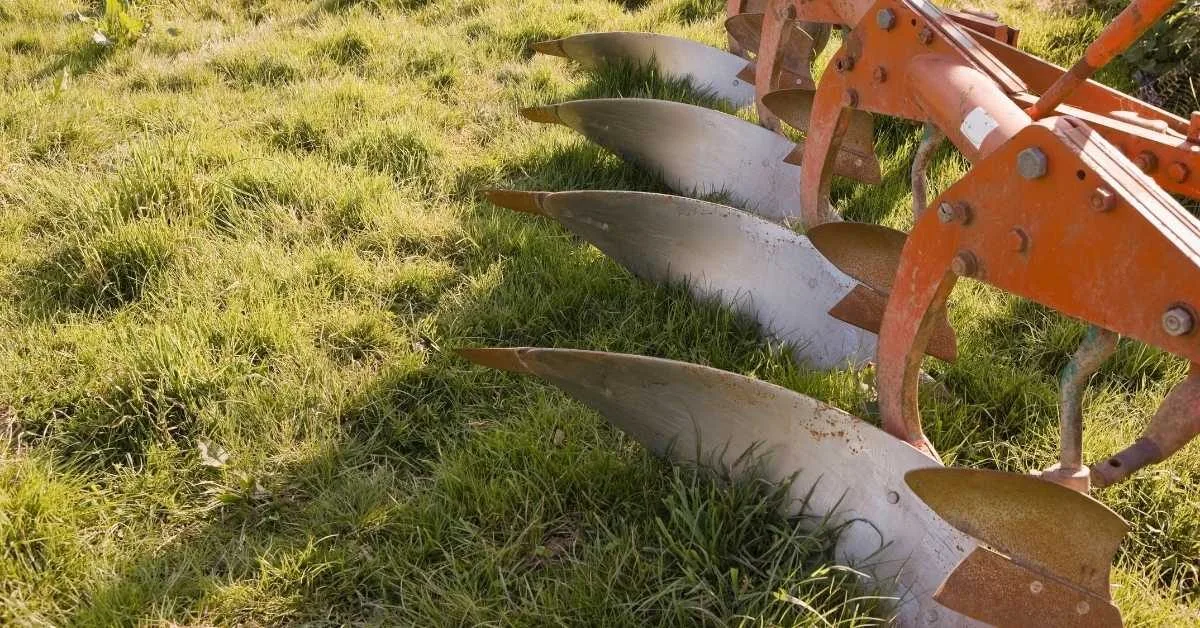
Cultivator coulters are the parts responsible for penetrating the ground, cutting the soil and moving it to the set working depth. Their design determines how the soil is broken up, how the residues are mixed and how much resistance the implement encounters as it moves forward.
When you fit the right ploughshare:
- The cultivator enters the soil easily.
- The work is more uniform.
- Diesel consumption is kept under control.
If the ploughshare is not suitable for that terrain, you will quickly notice more effort, a poorer finish and greater wear.
What is a swallowtail plough and how does it differ from a straight plough?
A swallowtail plough is a specific type of plough that incorporates side wings, which increase the working width on the surface. Its function is not to dig deeper, but to widen the cut and work a larger strip of soil with each pass.
Compared to a straight plough, a swallowtail plough:
- Cuts more surface area at the same depth.
- Mixes plant debris better.
- Promotes more superficial and uniform tillage.
That is why it is often used when you want to control weeds or work in minimum tillage systems.
Differences between swallowtail and straight tiness
The choice between straight or swallowtail tines depends on the purpose of the tillage, not just the type of cultivator.
- Straight coulters
These are useful when you need penetration, especially in hard or compacted soils. They work in a more concentrated way and require less cutting width, which makes it easier to enter difficult terrain. - Swallow coulters
These are more suitable for surface work, weed control and mixing residues. By covering more surface area, they reduce the number of passes, but require soils that allow for smooth progress.
Choosing one or the other directly influences the result of the soil and the consumption of the tractor-cultivator combination.
Wide wing swallowtail coulters: when they are suitable
Wide wing swallowtail coulters further increase the working width and are designed for very specific situations. They are particularly suitable when:
- You practise minimum tillage and do not want to disturb deep layers.
- You are looking for a continuous surface cut to control weeds.
- You work on medium or light soils without excessive compaction.
On hard or very dry soils, fitting wings that are too wide can cause greater resistance, vibrations and premature wear, so it is advisable to carefully consider their use before installing them.
Types of cultivator tines according to terrain
Soil type is one of the factors that most influences cultivator performance. Not all tines work equally well in hard, loose soil or in minimum tillage systems, and using the wrong option often results in poor performance, higher consumption and premature wear.
Ploughshares for hard or dry soils
When working on hard, dry or very compacted soils, the main challenge is to achieve penetration without forcing the assembly. In these cases, you need a ploughshare that concentrates the effort and facilitates entry into the ground.
The following usually work best:
- Straight or narrow ploughshares, which reduce resistance to forward movement.
- Robust designs that can withstand high impacts and stresses.
- Materials with good wear resistance, as this type of soil accelerates deterioration.
If you fit coulters that are too wide in these conditions, you will immediately notice more vibrations, higher consumption and uneven wear.
Coulter blades for medium and light soils
In medium or light soils, you have more choice, as the terrain allows for smoother working. Here you can prioritise performance and working width over pure penetration.
In this type of terrain:
- Swallowtail coulter blades offer very good results.
- You can cover more ground with each pass.
- The soil finish is usually more uniform.
Taking advantage of this allows you to reduce the number of passes and optimise time, provided that the soil does not have any specific areas of compaction.
Ploughs for minimum tillage and conservation agriculture
If you work with minimum tillage or conservation agriculture systems, the objective changes: you are not looking to remove soil at depth, but rather to cut, mix residues and maintain soil structure.
In these cases, you will want:
- Ploughs or shallow working ploughs.
- Wider wings to ensure continuous cutting.
- Designs that promote the mixing of plant debris without lifting deep layers.
The key is to adjust the depth correctly and choose a plough that works steadily, without generating excessive resistance or unnecessarily altering the soil profile.
Wear-resistant cultivator tines: when it is worth investing more
Investing in wear-resistant tines is not always essential, but in certain scenarios it makes a clear difference.
It is worth opting for this type of tine when:
- You regularly work on abrasive or stony soils.
- The blades wear out quickly and repeatedly.
- You want to reduce downtime and frequent part replacements.
Although the initial investment is higher, in the medium term it translates into more working hours, fewer replacements and greater regularity in tillage, which is especially important in demanding campaigns.
Cultivator arms: much more important than they seem
The cultivator arm is the element that transmits force to the soil. Although it is often given less importance than the ploughshare, its design determines the stability of the implement, the working depth and the wear and tear of the whole unit. If the arm is not suitable, even the best set of ploughshares will not give the expected results.
Function of the cultivator arm in tillage
The arm performs several key functions during work:
- It keeps the ploughshare stable at the desired depth.
- It absorbs or transmits impacts depending on its design.
- It influences vibration, consumption and the regularity of tillage.
When the arm is not adapted to the terrain, common problems arise: excessive vibrations, ploughshares that do not work evenly or premature breakage in critical areas.
Types of cultivator arms and their uses
Not all arms behave the same way. Choosing one or the other depends on the type of soil, the working depth and the presence of obstacles such as stones or hard debris.
Rigid cultivator arm
The rigid arm is the simplest and most straightforward. It transmits all the force to the soil without cushioning.
It is suitable when:
- You are working on uniform, stone-free soil.
- You are looking for precise depth control.
- You are performing relatively shallow or stable tasks.
On hard or obstacle-strewn terrain, this type of arm transmits all impacts to the chassis and plough, which can accelerate wear and tear.
Spring cultivator arm
The spring arm incorporates a flexing system that absorbs shocks and adapts better to uneven terrain.
It is particularly useful if:
- You work on variable or stony soils.
- You want to reduce vibrations and breakages.
- You are looking for greater working comfort and protection for the implement.
This type of arm offers a good balance between penetration and stress absorption, which usually translates into greater durability of the assembly.
Cultivator snail arm
The snail arm is designed for more demanding jobs, combining flexibility and the ability to return to its initial position.
It is particularly useful when:
- You work on very hard or stony ground.
- You need to maintain depth without damaging the implement.
- You are looking for a robust solution for intensive works.
Its design allows it to overcome obstacles without transmitting sudden shocks to the cultivator, although it requires a structure that is compatible with this type of arm.
Complete chisel arms and compatibility
In many cases, choosing complete chisel arms simplifies the cultivator configuration. These assemblies integrate the arm, support and fastening system, ensuring better compatibility between components.
Before choosing them, you should check:
- Compatibility with the cultivator chassis.
- The type of coulter you are going to mount.
- The type of tillage you usually perform.
The right combination of arm and coulter is key to achieving effective, stable tillage with less wear and tear, regardless of the type of soil.
How to choose ploughshares and cultivator arms according to your soil
The choice of ploughshares and arms should not be based on habit or price. For effective tillage, you need to adjust each component to the type of soil and the actual working depth. When this relationship is not consistent, the result is often higher consumption, accelerated wear and an uneven finish.
Relationship between soil type, depth and ploughshare shape
The shape of the coulter must be adapted to both the soil and the depth at which you are working:
- In hard or compacted soils, it is advisable to prioritise narrower or straighter coulters, which concentrate the effort and facilitate penetration to greater depths.
- In medium or loose soils, you can use wider or swallow-shaped coulters, which increase the working surface without compromising forward movement.
- For shallow work or minimum tillage, curved and wide wings offer a continuous cut that improves weed control and residue mixing.
If you force a wide ploughshare to work at depth or in hard soils, the problem will not only be wear and tear: the cultivator will tend to lift, vibrate or work unevenly.
Common mistakes when choosing cultivator spare parts
A series of mistakes are often made in the field that should be avoided if you want to optimise the performance of your cultivator:
- Always fitting the same type of coulter regardless of the soil or the season.
- Prioritising price without taking durability and wear into account.
- Combining wide coulters with arms that are unsuitable for the terrain.
- Not checking compatibility between the arm, coulter and chassis.
- Waiting until the coulter is completely worn out before replacing it.
Correcting these mistakes usually has an immediate impact on the results of tillage, consumption and the useful life of spare parts, without the need to change the implement.
Optimise your tillage with the right spare parts
Choosing the right coulters, tines and cultivator arms makes the difference between efficient tillage and tillage that generates unnecessary consumption, premature wear and uneven results. When you adapt each component to the type of soil and the objective of the job, you improve the performance of the cultivator and reduce costs in the medium term.
At Agrícola Navarro, we have been manufacturing agricultural spare parts for decades and advising farmers and technicians on the choice of components for effective tillage. If you have any doubts about which blades or arms are best suited to your cultivator, you can count on technical advice tailored to your specific case, without generic solutions.
Request technical information or consult which blades and arms are best suited to your cultivator.
And, if you want to learn more about the different options available, you can consult our product catalogue.